


C02 – Chemical ordering and dislocation defect phases in ternary intermetallics


PI: Prof. Dr. Sandra Korte-Kerzel (RWTH Aachen University, Institute for Physical Metallurgy and Materials Physics)
SFB researchers: Lukas Berners (RWTH Aachen University, Institute for Physical Metallurgy and Materials Physics)
In the first funding period, we explored co-deformation in Mg-Laves phase composite samples along a large parameter space. This included different alloy compositions, microstructures containing skeletons of variable connectivity or individual particles of C14, C36 and C15 Laves phases. We covered deformation conditions varying from room temperature to 170 °C and strain rates from creep to quasi-static conditions in both macroscopic (quasi)-in-situ-testing and indentation at different sizes. We further supplemented our analyses by using both detailed analysis of locally observable mechanisms across the scales using SEM and TEM and a machine learning based statistical analysis of co-deformation mechanisms observable by SEM. Using these methods, we successfully induced and studied co-deformation between the α-Mg and different Laves phases in close collaboration with partner projects using our information to construct representative computational models and extract specimens for atomic resolution analysis. We revealed a strong dependence of alloy performance on microstructure morphology, with a connected skeleton performing best. Furthermore, we identified a transition in dominant co-deformation mechanism at stress concentration sites with strain rate, highlighting the importance of understanding the thermally activated co-deformation mechanisms to guide materials design.
Depending on deformation conditions, engineering of these composites should focus either on the reinforcing Laves phase itself (for high rate application) or the interfaces (for low rate/creep applications).
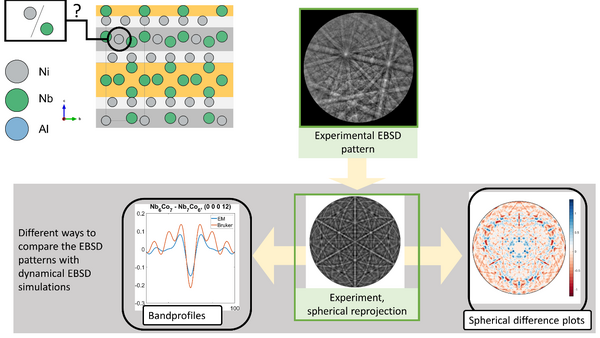
For the second funding period, we will focus on the new Ni-based material system around Ni-Nb(Al,Cu) and address a key challenge identified in the first period, namely the ability to efficiently and reliably identify and separate structurally similar intermetallic crystals. Therefore, we will initially focus on the development of advanced EBSD analyses for intermetallic phases with and without defects. Building on this method development, we will explore the effect of local chemical re-ordering on dislocation defect phase transitions. Two topics will be explored in this context: (1) the effect of off-stoichiometry and ternary alloying with Cu and Al in the Ni6Nb7 μ-phase and (2) the impact of element exchange on one sublattice in the ternary Nb(Ni,Al)2 C14 Laves phase. Together with closely collaborating projects, in particular A03, A05, A07n, and B01, this project will therefore drive the development of new methods for defect phase analysis and the investigation of the mechanisms of motion of dislocation defect phases in intermetallics.
Publications:
- [1] M. Zubair, S. Sandlöbes-Haut, et al. (2021), Co-deformation between the metallic matrix and intermetallic phases in a creep-resistant Mg-3.68Al-3.8Ca alloy Materials & Design (210), pp. 110113 - DOI:10.1016/j.matdes.2021.110113
- [2] J. Guénolé, M. Zubair, et al. (2021), Exploring the transfer of plasticity across Laves phase interfaces in a dual phase magnesium alloy, Materials & Design (202), pp. 109572 - DOI: 10.1016/j.matdes.2021.109572
- [3] M. Zubair, M. Felten et al. (2023), Laves phases in Mg-Al-Ca alloys and their effect on mechanical properties, Materials & Design (225), pp. 11470, DOI: 10.1016/j.matdes.2022.111470
- [4] M. Zubair, S. Sandlöbes et al. (2023), Strengthening of Mg-Al-Ca alloys with C15 and C36 Laves phases, Journal of Materials Research (38), pp. 3613-3627, DOI: 10.1557/s43578-023-01082-x
- [5] S. Medghalchi, M. Zubair et al. (2023), Determination of the Rate Dependence of Damage Formation in Metallic-Intermetallic Mg-Al-Ca Composites at Elevated Temperature using Panoramic Image Analysis, Advanced Egineering Materials 25, pp. 2300956, DOI: 10.1002/adem.202300956
- [6] D. Andre, M. Freund et al. (2022), Metallographic preparation methods for the Mg based system Mg-Al-Ca and its Laves phases, Materials Characterization (192) pp. 112187. DOI: 10.1016/j. matchar.2022.112187
- [7] M. Freund, D. Andre, et al. (2021), Plastic deformation of the CaMg2 C14-Laves phase from 50 - 250°C, Materialia (20) pp. 101237. DOI: 10.1016/j.mtla.2021.101237
- [8] Gibson, J. S. K.-L.; Pei, R.; Heller, M.; Medghalchi, S.; Luo, W.; Korte-Kerzel, S. Finding and Characterising Active Slip Systems: A Short Review and Tutorial with Automation Tools. Materials 14 (2) (2021), 407. DOI: 10.3390/ma14020407, source Code : https://doi.org/10.3390/ma14020407
- [9] Korte-Kerzel, S.; Hickel, T.; Huber, L.; Raabe, D.; Sandlöbes-Haut, S.; Todorova, M.; Neugebauer, J. Defect Phases – Thermo-dynamics and Impact on Material Properties. International Materials Reviews 2021, 1–29. DOI: 10.1080/09506608.2021.1930734.
- [10] Xie, Z., Chauraud, D., Atila, A., Bitzek, E., Korte-Kerzel, S., Guénolé, J. , Unveiling the mechanisms of motion of synchro-Shockley dislocations in Laves phases, Physical Review Materials 7, pp. 053605, DOI: 10.1103/PhysRevMaterials.7.053605, Source Code : https://zenodo.org/record/4560051#.Y1Y4FbTP1aQ
- [11] Zhang, T.; Berners, D.; Holzer, J.; Britton, T. B.; Comparison of Kikuchi Diffraction Geometries in Scanning Electron Microscope, arXiv preprint, DOI: 10.48550/arXiv.2411.13018